

Translation Seminar Series

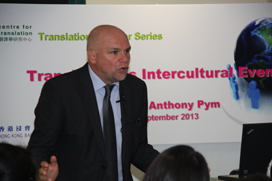
Translation as Intercultural Event

Date: 25/09/2013
Time: 12:00 am - 12:00 am
Speaker: Professor Anthony Pym
Translation Seminar Series

Belated interest in the aesthetics of the event (variously from Badiou) has brought renewed attention to the performative nature of translation. Part of this might be attached to the technologies that now favour groups of volunteer translators, who are at once the producers and consumers of translations (hence “prosumers”).
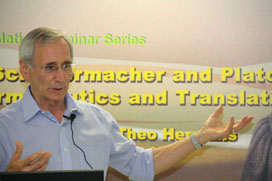
Schleiermacher and Plato, Hermeneutics and Translation

Date: 26/07/2013
Time: 12:00 am - 12:00 am
Speaker: Professor Theo Hermans
Translation Seminar Series

Schleiermacher's German translation of Plato's philosophical dialogues, the first five volumes of which appeared between 1805 and 1809, has received little attention from students of translation. Yet it embodies Schleiermacher’s understanding of Plato, which he further elaborated in the introductions he wrote to each of the dialogues and in his general introduction to Plato’s work as a whole.

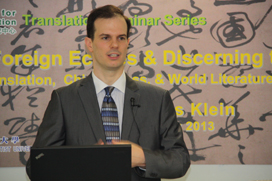
Foreign Echoes & Discerning the Soil: Dual Translation, Chineseness, & World Literature in Chinese Poetry

Date: 30/05/2013
Time: 12:00 am - 12:00 am
Speaker: Dr Lucas Klein
Translation Seminar Series

What constitutes the relationship between world literature and Chineseness? How has translation shaped Chinese poetry, and can translation be understood as at the foundation not only of world literature, but of Chineseness, as well? This talk will begin to answer these questions by demonstrating how Chineseness as an aspect of the Chinese poetic tradition is itself a result of translation.

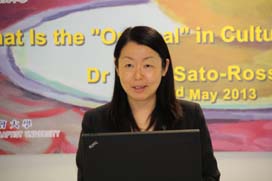
What Is the “Original” in Cultural Translation?

Date: 23/05/2013
Time: 12:00 am - 12:00 am
Speaker: Dr Nana Sato-Rossberg
Translation Seminar Series

Those with an interest in Ainu oral narratives will soon come across the name of Mashiho Chiri (1909 - 1961), who today would be called a 'native anthropologist'. Mashiho's translation style is strongly influenced by the work of his well-known sister, Yukie Chiri (1903 - 1922). Regrettably, most translations of Mashiho appeared only with the Japanese text.

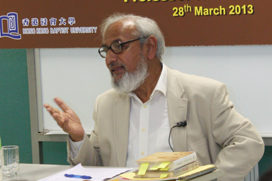
Self-Translation and the Nobel Prize: 100 years of Tagore’s Gitanjali

Date: 28/03/2013
Time: 12:00 am - 12:00 am
Speaker: Professor Harish Trivedi
Translation Seminar Series

The first non-European and Asian writer to win the Nobel Prize for Literature was the Indian poet Rabindranath Tagore; he is still the only Indian to win the prize and one of under half a dozen writers from Asia. Though the prize is awarded not for a single book but for a body of work, Tagore won it apparently for just one slim book of poems published in his own English translation under the non-translated title Gitanjali (A Handful of Offerings of Songs; 1912).

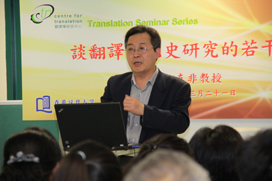
談翻譯文化史研究的若干模式

Date: 21/03/2013
Time: 12:00 am - 12:00 am
Speaker: Professor Wang Kefei
Translation Seminar Series

翻譯文化史重在探討翻譯對於文化(尤其是譯入語文化)的意義和影響,翻譯在文化史上的作用,以及文化對翻譯的制約。翻譯的過程也是一個文化感受的過程,它不同程度地包含著理解、比較、選擇、融會和創新,從中可以對翻譯的原因和意義獲得更充分的理解。
不同於一般翻譯史的是,翻譯文化史注重對種種翻譯現象、事件作文化傳播意義上的分析與解釋,而不僅僅是翻譯史實的敍述和鈎沉;即不僅僅是描述性的,還應是解釋性的。

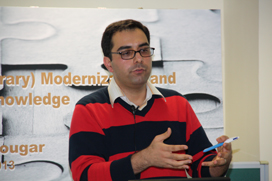
Institutions of Translation, (Literary) Modernization and the Problem of Knowledge

Date: 28/02/2013
Time: 12:00 am - 12:00 am
Speaker: Dr Omid Azadibougar
Translation Seminar Series

A notion that has long dominated our understanding of the role of translation in (literary) modernization comes from postcolonial theories that emphasize the agency of the translational space (i.e. the third space) in the process of “importing” ideas. The descriptive and analytic limits of post-colonial thoughts are due to their reliance on colonial institutions (e.g. languages, literatures, universities, etc.) which are/were immediately available and advantageous to them.

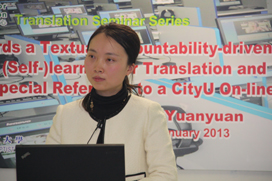
Towards a Textual Accountability-driven Mode of Teaching and (Self-)learning for Translation and Bilingual Writing: With Special Reference to a CityU On-line Teaching Platform

Date: 31/01/2013
Time: 12:00 am - 12:00 am
Speaker: Dr Mu Yuanyuan
Translation Seminar Series

Teaching translation in a research-informed instead of an impressionistic manner to ensure the pedagogical quality of translator training is, ceteris paribus, dependent on the extent to which the formulation of a text, be it a source or a target text, can be perceived and explained as accountable for its function and effect. This presentation will focus on an on-line platform (the Platform) specifically designed for an accountability-driven mode of teaching and (self-)learning for translation and bilingual writing, which is currently under construction at the City University of Hong Kong.

Translation and Globalization. Why, How and Where Translation May be a Key to the Dynamics of Culture

Date: 06/12/2012
Time: 12:00 am - 12:00 am
Speaker: Professor José Lambert
Translation Seminar Series

This lecture focuses on fundamental and fast GLOBAL(izing) changes;
In fact most academic guest lectures are an illustration of mobility (in – scholarly – communication). (Cf. Ong 1982.)
In the present case: (a) intercontinental contacts/exchanges (are in fast progress); (b) the focus is on (global and other) Communication

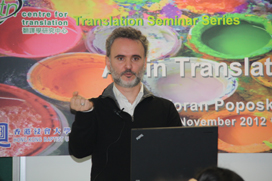
Art in Translation

Date: 29/11/2012
Time: 12:00 am - 12:00 am
Speaker: Mr Zoran Poposki
Translation Seminar Series

There is a growing tendency in contemporary art to explore the bonds and interconnections between text and image. The plethora of possible relations between the textual and the visual, across a variety of contemporary art practices, creates a vast geography of image as language and language as image, from typography to language-based art practices.

Scroll to top