

Translation Seminar Series

Mutual Acceptance between American Redology and the Two English Versions of Hong Lou Meng

Date: 25/10/2012
Time: 12:00 am - 12:00 am
Speaker: Dr Zhang Hui
Translation Seminar Series

There exists mutual acceptance and interaction between American Redology and the two English versions of Hong Lou Meng. Obviously, the translations influence American Redology and are also being influenced by American Redology. The translation serves to enhancing reputation and foreign understanding of the original text, hence making it not only a part of Redology, but also a key element in promoting the Redology and enriching the original.
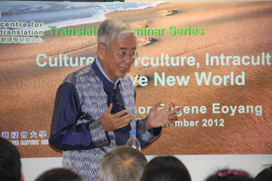
Culture, Interculture, Intraculture: Brave New World

Date: 27/09/2012
Time: 12:00 am - 12:00 am
Speaker: Professor Eugene Eoyang
Translation Seminar Series

“Culture—Interculture—Intraculture” identifies three stages of cultural identity: cultural: where the foreign is clearly marked, as in Euripides’s Medea, the book of Ruth in the Bible, Shakespeare’s Henry V; intercultural: where the foreign is absorbed in the native, as in the Pole Joseph Conrad, the Czech Tom Stoppard, and the Japanese Kazuo Ishiguro in Great Britain, the Pole Czelaw Milosz, the Russians Vladimir Nabokov and Josef Brodsky in the United States; and the Romanians Paul Celan, E. M. Cioran, Eugène Ionesco, the Irishman Samuel Beckett, and the Chinese François Cheng in France.

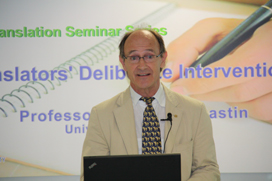
Translators’ Deliberate Interventions

Date: 06/08/2012
Time: 12:00 am - 12:00 am
Speaker: Professor Georges L. Bastin
Translation Seminar Series

Shifts in translation have been extensively visited and revisited. Many different taxonomies exist that intend to list most decisions taken or choices made by translators, be these decisions called shifts, techniques, procedures or strategies. The problem is that there's no explicit distinction between compulsory and deliberate interventions.

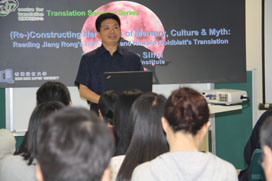
(Re-)Constructing Narratives of Memory, Culture & Myth: Reading Jiang Rong’s Wolf Totem and Howard Goldblatt’s Translation

Date: 24/05/2012
Time: 12:00 am - 12:00 am
Speaker: Professor Mao Sihui
Translation Seminar Series

Jiang Rong's semi-autographical novel Lang Tu Teng (《狼圖騰》, first published in 2004) has been a huge literary triumph (winner of the Man Asian Literary Prize in 2007) and an unprecedented cultural phenomenon in Mainland China, breaking all-time sales records as the second most read book after Chairman Mao's little red book. Howard Goldblatt's lucid translation of Wolf Totem (2008) has also made the novel into an exciting popular work of narrative fiction for the international community of literary readers and cultural critics.

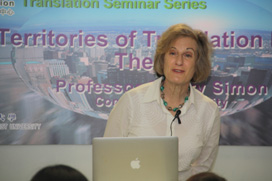
New Territories of Translation Research: the City

Date: 03/05/2012
Time: 12:00 am - 12:00 am
Speaker: Professor Sherry Simon
Translation Seminar Series

This seminar will explore the ways in which the city has become an object of translation studies - by investigating some of the recent advances in translation theory that expand the field. Work to be discussed, among others, are books by Michael Cronin, Doris Sommer, Emily Apter, Maria Tymoczko, Edwin Gentzler, Vicente Rafael.

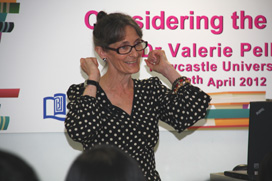
Considering the Reader

Date: 12/04/2012
Time: 12:00 am - 12:00 am
Speaker: Dr Valerie Pellatt
Translation Seminar Series

In the study and discussion of translation, the reader has not gone unnoticed, and deservedly is becoming more important to translatologists. Readers of translations span a spectrum, from those who do not speak any foreign language, and urgently need a translation for instrumental purposes, such as a manual, to those who, in spite of their proficiency in the target language, choose to read a translation in order to exercise their powers of critical analysis.

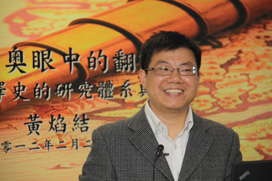
Translation in the Eyes of Klio: A Preliminary Research into Translation History

Date: 23/02/2012
Time: 12:00 am - 12:00 am
Speaker: Mr Huang Yanjie
Translation Seminar Series

Translation history, specializing in translation phenomena through history, has earned a niche in the hall of Klio, the mythical Muse of history. The knowledge system of translation history prepares for its research system as an inter-disciplinary subject. Then what is translation history? And what is its relationship with both history and translation studies?

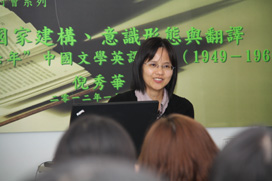
Nation-building, Ideology and Translation – A Study on English Translations of Chinese Literature in the First Seventeen Years of the PRC (1949-1966)

Date: 12/01/2012
Time: 12:00 am - 12:00 am
Speaker: Ms Ni Xiuhua
Translation Seminar Series

The first seventeen years of the People's Republic of China (1949-1966) was a critical period for the newly-born modern Chinese nation to gain recognition in the international world. The same period also witnessed a unique translation activity, i.e. source culture-generated translation of a large number of classical and modern/contemporary Chinese literature into English and other foreign languages mainly undertaken by teams of Chinese and foreign translators in the Foreign Languages Press (FLP) in Beijing, a state-sponsored institute, in an attempt to reshape the image of China, hence rendering legitimacy to the newly-born nation.

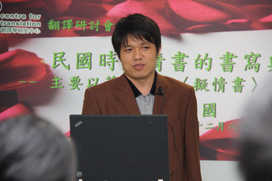
The Creation and Translation of Love Letters in the Republican Era of China – A Case Study on Mao Dun’s Translation of The Heroides

Date: 08/12/2011
Time: 12:00 am - 12:00 am
Speaker: Mr Lu Zhiguo
Translation Seminar Series

The creation, translation and publication of love letters boomed in the1920s-1930s, a period of the Republican Era of China. Quite a few renowned writers or the young keen to be literarily known were then in an effort to publish their love letters or novels written in letter format, or to render the love letters of famous persons.

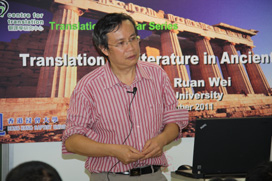
Translation of Literature in Ancient Greece

Date: 24/11/2011
Time: 12:00 am - 12:00 am
Speaker: Professor Ruan Wei
Translation Seminar Series

The translation of the Bible into Greek before Christianity took shape is well-known, but the translated nature of ancient Greek literature as a whole before Christianity emerged has not yet been fully explored. The present paper argues that ancient Greek literature was heavily indebted to West Asia.

Scroll to top