

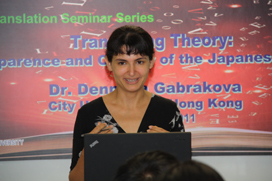
Translation Seminar Series

Translating Theory: The Transparence and Opacity of the Japanese Intellectual

Date: 13/10/2011
Time: 12:00 am - 12:00 am
Speaker: Dr Dennitza Gabrakova
Translation Seminar Series

This presentation will focus on the significance of translation of theory for the self-fashioning of a type of identity of the Japanese intellectual. After briefly outlining the significance of translation for Japanese modernity, the work of several translators of theory will be discussed.
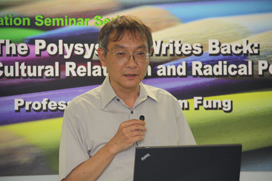
The Polysystem Writes back: On Prescriptive Cultural Relativism and Radical Postcolonialism

Date: 25/08/2011
Time: 12:00 am - 12:00 am
Speaker: Professor Chang Nam Fung
Translation Seminar Series

In the past two decades there has been a tendency to politicize translation studies and other disciplines in the humanities, alleging that the dominance of theories originating from the West is the result of power differentials instead of academic merits. Scholars of periphery origin who embrace central theories and values are accused of "self-colonization".

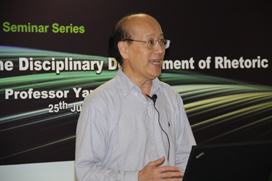
Translation and the Disciplinary Development of Rhetoric

Date: 25/07/2011
Time: 12:00 am - 12:00 am
Speaker: Professor Yameng Liu
Translation Seminar Series

While a rhetorical perspective on translation has started to attract scholarly attention, translation's impact on the disciplinary development of rhetoric remains unexplored by practitioners in the fields concerned. Even a cursory look into rhetoric's long history, however, would turn up much evidence of translation's crucial role in shaping up the conceptual and institutional contours of the art of persuasion.

Why Bother? – Subtitling with Cantonese

Date: 23/06/2011
Time: 12:00 am - 12:00 am
Speaker: Dr Gloria Lee Kwok-kan
Translation Seminar Series

Subtitles do not simply transcribe the dialogues of a film. Subtitles involve specific groups of audience and seek to enhance their viewing experience. Based on this function of subtitling, I examine the Chinese/Cantonese subtitles provided in the DVDs of two films: The Brothers Grimm (2005) and Shrek 2 (2004).

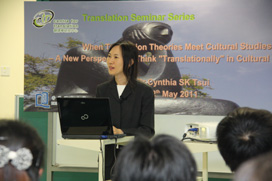
When Translation Theories Meet Cultural Studies – A New Perspective to Think “Translationally” in Cultural Criticism

Date: 12/05/2011
Time: 12:00 am - 12:00 am
Speaker: Dr Cynthia SK Tsui
Translation Seminar Series

What would happen if translation theories and cultural studies talk to each other? In this talk, Dr Cynthia Tsui will reveal that "translation" can be used as a thinking method that sheds light on other disciplines. Although translation is traditionally viewed as a linguistic practice, it visualizes a reasoning model of the "in-between".

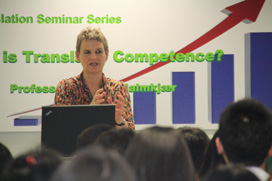
What is Translator Competence?

Date: 07/04/2011
Time: 12:00 am - 12:00 am
Speaker: Professor Kirsten Malmkjær
Translation Seminar Series

In this seminar, I will compare the concept of Translation Competence with a concept that I have called Translator Competence and which is more closely associable with (though very far from alignable with) the notion of competence which we find at play in theoretical linguistics.

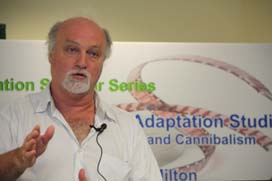
Translation Studies and Adaptation Studies: Appropriation, Recreation and Cannibalism

Date: 03/03/2011
Time: 12:00 am - 12:00 am
Speaker: Professor John Milton
Translation Seminar Series

Adaptation Studies have become very popular in recent years in many university departments, especially those of English Literature and Film Studies, with a growing number of books, conferences and journals in the area. This talk begins by examining the interface (or lack of interface) between Translation Studies and Adaptation Studies, also introducing the concept of appropriation, and examples will be given from adaptations and appropriations of the works of William Shakespeare, particularly Othello.

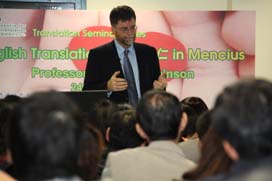
English Translations of rén 仁 in Mencius

Date: 24/02/2011
Time: 12:00 am - 12:00 am
Speaker: Professor Douglas Robinson
Translation Seminar Series

Chinese-English dictionaries typically offer as the closest English equivalents of rén 仁 “benevolent/-ce, kind/ness, humane/ness,” and Mencius’s English translators by and large stick to those translations as well. Following the lead of James Legge, for example, D. C. Lau and the translators of the Shandong Friendship Press edition meticulously translate it in almost every case as “benevolent” or “benevolence,” and most Mencius scholars writing in English, whether Chinese or non-Chinese, also translate it as “benevolent/-ce”; David Hinton uses “humane” and “humanity.”

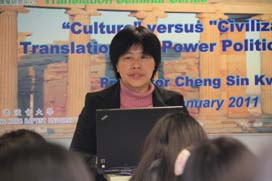
“Culture” versus “Civilization”: Translation and Power Politics in Europe

Date: 27/01/2011
Time: 12:00 am - 12:00 am
Speaker: Professor Cheng Sin Kwan
Translation Seminar Series

By the nineteenth century, "culture" and "civilization" had been translated into different languages in Europe and beyond, and both came to be regarded in the West as "international" concepts. A careful study of the translation history of these two terms, however, would reveal that European internationalism was not only deeply implicated in colonialism, but also heavily fraught with nationalism inside Europe.

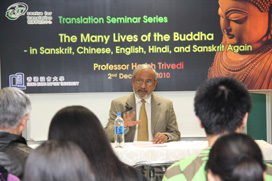
The Many Lives of the Buddha – in Sanskrit, Chinese, English, Hindi, and Sanskrit Again

Date: 02/12/2010
Time: 12:00 am - 12:00 am
Speaker: Professor Harish Trivedi
Translation Seminar Series

The foundational narrative of the life and deeds of the Buddha (c. 557- 483 BC) is the Sanskrit epic Buddhacharitam by Ashvaghosha (1st century AD). As part of the great enterprise of translating Buddhist texts from Sanskrit, this work too was translated into Chinese as Fo-Sho-Hing-Tsan-King by Dharmaraksha (420 AD).

Scroll to top