

Translation Seminar Series

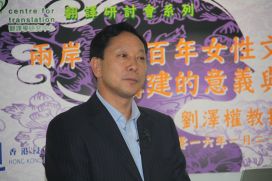
A Critical History of Women’s Literary Translations of the Mainland, Taiwan and Hong Kong (1900-2000): Its Significance and Methods

Date: 21/01/2016
Time: 12:00 am - 12:00 am
Speaker: Professor Liu Zequan
Translation Seminar Series

Chinese women's appearance on the scene of literary translation has been a long-acknowledged fact. The earliest written record of Chinese women's translation can be traced back to 1898, and the first woman's translation of western literature is Xue Shaowei's (1900) rendition of the French writer Jules Gabriel Verne's Le Tour du monde en quatre-vingts jours (Around the World in 80 Days), though via its Japanese version.
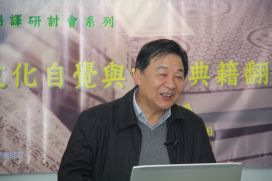
Cultural Consciousness and the English Translation of Chinese Classics

Date: 21/12/2015
Time: 12:00 am - 12:00 am
Speaker: Professor Luo Xuanmin
Translation Seminar Series

文化自信與文化自覺相輔相成,但文化自覺過去沒有得到足夠的重視。 要提升國家形象需要有高度的文化自覺,文化自信只有建立在文化自覺之上才是可靠的。就翻譯而言,文化自覺的最終目的就是要在不損害中國文化精神的前提下,以最合適的方式來解讀和翻譯最合適的典籍材料,從而達到消解分歧,促進中外文化的交流,極大地滿足西方受眾閱讀中國典籍的需要。

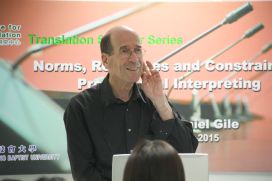
Norms, Resources and Constraints in Professional Interpreting

Date: 26/11/2015
Time: 12:00 am - 12:00 am
Speaker: Professor Daniel Gile
Translation Seminar Series

Interpreting has become a visible and attractive profession in some parts of the world, but many people know little about what it involves in its various branches above and beyond a good mastery of the working languages. Far from being 'language converting devices', interpreters constantly analyze incoming (source language) speeches and make decisions on what and how to formulate their target-language speeches.

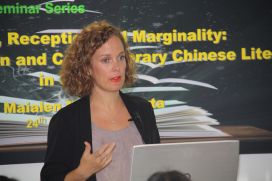
Mediation, Reception and Marginality: Translations of Modern and Contemporary Chinese Literature in Spain

Date: 24/09/2015
Time: 12:00 am - 12:00 am
Speaker: Dr. Maialen Marin-Lacarta
Translation Seminar Series

Eighty four translations of modern and contemporary Chinese literature were published in Spain between 1949 and 2010. The history of this under researched corpus of translations and their reception will form the basis of the discussion in this seminar. I will try to demonstrate two interrelated arguments: the marginality of modern and contemporary Chinese literature in Spain and the mediation of the Anglophone and Francophone literary systems in the Spanish reception.

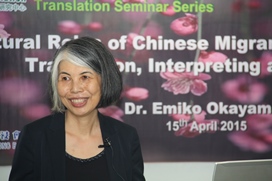
Cultural Roles of Chinese Migrants in Edo Japan: Translation, Interpreting and Beyond

Date: 15/04/2015
Time: 12:00 am - 12:00 am
Speaker: Dr. Emiko Okayama
Translation Seminar Series

During Japan's self-imposed isolation (1639-1859), Nagasaki was the country's only port open for international trade: merchants from two nations, Holland and China, were granted access. While in Nagasaki, the Dutch and Chinese were each confined to their own tightly controlled districts: on Dejima Island 出島 (from 1639) and in Tōjin yashiki 唐人屋敷 (Chinese Quarter, from 1689) respectively.

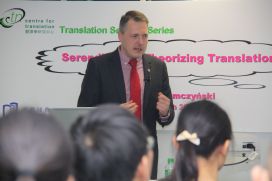
Serendipity in Theorizing Translation

Date: 23/03/2015
Time: 12:00 am - 12:00 am
Speaker: Dr. Piotr Blumczynski
Translation Seminar Series

Is translation indispensable or expendable? Is it a necessary evil and a constant reminder of our limitations or rather a powerful way of enlarging our understanding and experience? Is translation always benign, beneficial and positive or can it turn into a sinister, malign and ethically dubious activity?

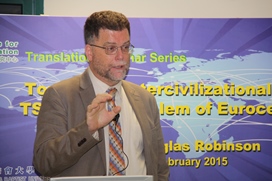
Toward an Intercivilizational Turn: TS and the Problem of Eurocentrism

Date: 05/03/2015
Time: 12:00 am - 12:00 am
Speaker: Professor Douglas Robinson
Translation Seminar Series

Charges of Eurocentrism have been troubling the TS scholarly community lately, leading recently to a prominent countercharge in the pages of Translation Studies from Andrew Chesterman, who argues that science is always universalist, and that cultural relativists who accuse scholars like him of Eurocentrism are therefore simply wrong.

Plagiarism, Irony and Incense Stick: A Sketch of Thai Translation Traditions

Date: 22/01/2015
Time: 12:00 am - 12:00 am
Speaker: Dr Phrae Chittiphalangsri
Translation Seminar Series

In the light of current translation studies scholarship, Southeast Asia is largely underresearched compared to other parts of Asia. Translation traditions in a region so diverse in politics, geographies and cultures such as this cannot easily be accommodated by established notions of literal vs free, domestication vs foreignisation, or the post-colonial pattern of appropriation, resistance and hybridity.

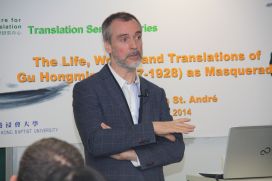
The Life, Works, and Translations of Gu Hongming (1857-1928) as Masquerade

Date: 04/12/2014
Time: 12:00 am - 12:00 am
Speaker: Professor James St. André
Translation Seminar Series

Joan Riviere's article "Womanliness as a Masquerade" will form the basis of a discussion of the late Qing intellectual and noted translator Ku Hung-ming. Specifically, this paper will argue that, just as some women can be seen as performing 'womanliness' as a masquerade, so too we may theorize the translations of Gu Hongming as a type of masquerade, a conscious adopting of a role that draws on pre-existing norms relating to that role.

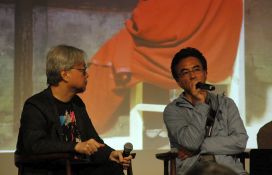
Cultural Translation: Speaking to you about me – Pema Tseden in dialogue with Evans Chan

Date: 31/10/2014
Time: 12:00 am - 12:00 am
Speaker: Pema Tseden & Evans Chan
Translation Seminar Series

Hong Kong film maker Evans Chan lives between Hong Kong and New York, making films and writing about Hong Kong to an international audience and reader. The inter-lingual, intercultural and inter-medial conditions face by both Evans Chan and Pema Tzeden are representative of contemporary creativity.

Scroll to top