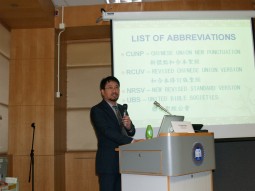
The Making of Revised Chinese Union Version (RCUV)
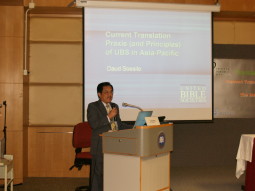
- What are involved in a Bible revision? (e.g. base texts, exegesis, language style etc.);
- Issues and challenges related to the making of RCUV;
- Scope of the revision of RCUV.



Promoting discipline of translation
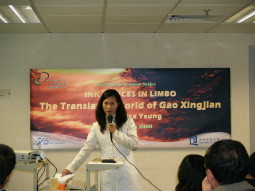
Reading Gao Xingjian's entire repertoire of writings prompts one to reflect on the relationship between literary production and its context. His works show both advantage and crisis of cross-cultural writing. In the early 1980s he advocated a Modernist style of writing in contemporary China.
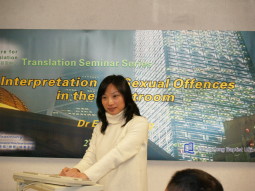
Since the enactment of the first Hong Kong bilingual ordinance in 1989, tremendous effort and resources have been put to translating English legal documents into Chinese. Long before the implementation of bilingual legislation, the provision of interpreting services has been an entrenched practice in the courtrooms of Hong Kong.
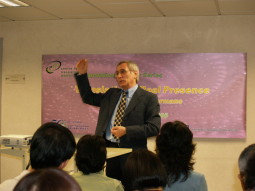
Can an author claim ownership of a translation on the grounds that it is the same 'work' as the original? How is an original 'present' in a translation? How do translations 'represent' originals? The seminar seeks answers to these questions by exploring some of the historical debates about the Christian doctrine of the Real Presence.
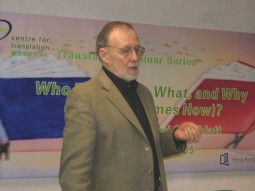
Howard Goldblatt has taught modern Chinese literature and culture for more than a quarter of a century. The foremost translator of modern and contemporary Chinese literature in the West, he has published English translations of more than thirty novels and story collections by writers from China, Taiwan, and Hong Kong.
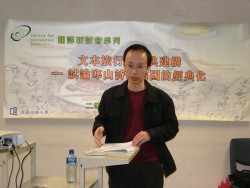
唐代詩人寒山在漫長的中國詩史中一直是寂寂無聞。然而到了20世紀50年代,他和他的詩卻獲得了所有中國"主流詩人"們也許永遠都無法企及的成就。在大洋彼岸,寒山成了美國年輕一代頂禮膜拜的精神領袖,寒山詩也成爲"舊金山文藝復興"的經典之作。到了20世紀80年代,第一個寒山詩全譯本問世,緊接著,在1990年又出現了第二個全譯本。與此同時,寒山詩更是全面進入美國各大文學選集和東亞文學的大學講堂。
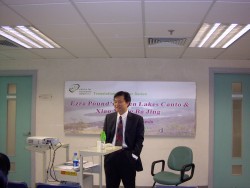
The Seven Lakes Canto is an important poem in understanding Ezra Pound's poetic writing, translation and cultural criticism. This talk traces various resources Pound had own to: the "screen book" from his parents, Miss Zeng's translation, then explores how Pound made it new and put the translation and other poems into writing of this Canto.
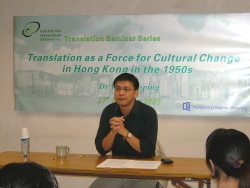
In 1956 Ma Lang (馬朗) launched Literary Current Monthly Magazine (文藝新潮) as a vehicle for publishing both creative work of Chinese writers and translations of modernist literature. These translations constituted the first systematic attempt in Hong Kong to introduce Chinese readers to modernist works from foreign literatures.
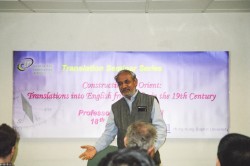
This is a postcolonially inflected historical narrative of translations from India during the "long" nineteenth century, ranging from 1777 when an Indian text was first translated into English, upto 1913 when a book of poems, self-translated into English by its Indian author, won him the Nobel prize.