

Translation Seminar Series

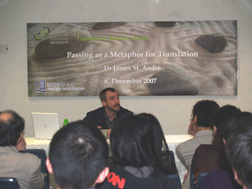
Passing as a Metaphor for Translation

Date: 06/12/2007
Time: 12:00 am - 12:00 am
Speaker: Dr James St André
Translation Seminar Series

A brief discussion of the general importance of metaphors as a way of breaking out of old frameworks of thought will be followed by an outline of how different types of translation may usefully be mapped onto various forms of passing (straight passing, blackface, whiteface, slumming, drag, mimicry), and how this new metaphor encourages the reformulation of notions of what the translation process involves, what the role of the translator is, and what some of its social effects might be.
Translation, Globalization and “Cultural Translation”

Date: 22/11/2007
Time: 12:00 am - 12:00 am
Speaker: Prof Harish Trivedi
Translation Seminar Series

Originally and etymologically, "translation" may have meant carrying across, but subsequently and metaphorically, the primary meaning of the term has come to be the transfer of literary and discursive texts from one language to another. Translation has thus formed a vital medium of communication and exchange across different cultures for over two millennia.

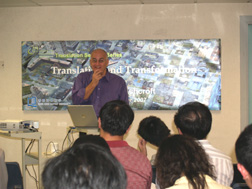
Translation and Transformation

Date: 25/10/2007
Time: 12:00 am - 12:00 am
Speaker: Prof Bill Ashcroft
Translation Seminar Series

The development of Translation Studies in the 1990s was the natural outcome of an increasing fluid and globalizing world. But that development was preceded by one that was much more political, much more resistant and yet one in which the spirit of translation figured strongly. This was the emergence of post-colonial studies at the end of the 1980s.

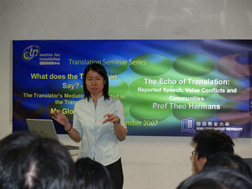
The Echo of Translation: Reported Speech, Value Conflicts and Communities

Date: 14/09/2007
Time: 12:00 am - 12:00 am
Speaker: Prof Theo Hermans
Translation Seminar Series

We mostly think of translation as endeavouring to render an original text in another language without addition, omission, distortion or bias. But what happens when translators find some of the things they are meant to translate objectionable? What if the scene of translation involves a clash of values?

What does the Translation Say? –The Translator’s Mediation as reflected in the Translation

Date: 14/09/2007
Time: 12:00 am - 12:00 am
Speaker: Ms Lee Kwok-kan Gloria
Translation Seminar Series

The translation discourse in the Republican Era consisted largely of articles and paratexts written by intellectuals in the literary field. Many of them had translated works in different genres from foreign languages into Chinese, motivated by the urge to bring in western knowledge as well as innovative rhetorical devices to enrich the vernacular language.

重寫與制約:從女性主義角度論《傲慢與偏見》的中譯本

Date: 30/08/2007
Time: 12:00 am - 12:00 am
Speaker: Ms Shao Yi
Translation Seminar Series

英國著名女作家簡•奧斯丁的《傲慢與偏見》在中國大陸流傳甚廣,譯本繁多,本研究運用女性主義理論與“重寫”理論,研究《傲慢與偏見》在中國大陸出版的全譯本與簡寫本,比較分析譯本與源文的異同,探討通過譯本在中國大陸傳播女性主義的新途徑。

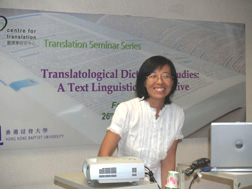
Translatological Dictionary Studies: A Text Linguistics Perspective

Date: 26/07/2007
Time: 12:00 am - 12:00 am
Speaker: Ms Fan Min
Translation Seminar Series

The present study strives to provide a general framework of translatological dictionary studies from the perspective of text linguistics by discussing the intimate relationship between translatological dictionary studies and text linguistics studies, the characteristics of translatological dictionary, the theoretical basis of translatological dictionary as text, and the seven textual criteria and translatological dictionary as text so as to investigate translatological dictionary comprehensively and systematically and further promote translation studies as a whole.

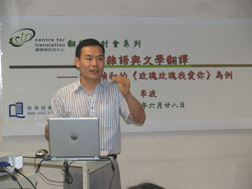
雜語與文學翻譯——以王禎和的《玫瑰玫瑰我愛你》為例

Date: 28/06/2007
Time: 12:00 am - 12:00 am
Speaker: Mr Li Bo
Translation Seminar Series

巴赫金在《長篇小說的話語》中提出了"雜語"這個概念,並且具體分析了長篇小說引進和組織雜語的幾種形式。本文回顧了近年來翻譯研究領域內對巴赫金的"雜語"這個概念的挪用,特別是"雜語"與多語文本、方言之間的關係及其在文學作品中的作用。這些社會雜語的方式,在翻譯過程中是否應該得到重視呢?在譯文中又是如何得到處理的呢?本文結合臺灣作家王禎和的長篇小說《玫瑰玫瑰我愛你》及其英譯本,對以上問題進行深入的探討。

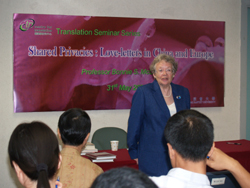
Shared Privacies: Love-letters in China and Europe

Date: 31/05/2007
Time: 12:00 am - 12:00 am
Speaker: Professor Bonnie S. McDougall
Translation Seminar Series

Love-letters are a rare example of a truly universal phenomenon. They can be found among all literate civilisations, although literacy is not a prerequisite for sending or receiving them. They are among our most treasured possessions, although the materials are often commonplace and pass through others' hands.

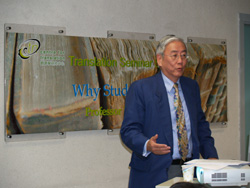
Why Study Literature

Date: 12/04/2007
Time: 12:00 am - 12:00 am
Speaker: Prof Eugene Chen Eoyang
Translation Seminar Series

"Why Study Literature" is an exploration of the heuristic benefits of studying literature, which includes the disciplined development of the following faculties: (1) creative imagination; (2) vicarious sympathy; (3) capacious intuition.

Scroll to top