

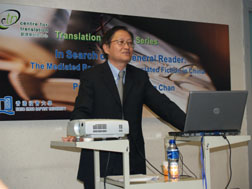
Translation Seminar Series

In Search of the General Reader: The Mediated Reception of Translated Fiction in China

Date: 02/10/2008
Time: 12:00 am - 12:00 am
Speaker: Professor Leo Tak-hung Chan
Translation Seminar Series

History-writing has received a great boost in Translation Studies research in the past decade. However, for many translation histories, reception is conceived largely in terms of how a translator reads a foreign text, not how the ordinary reader "receives" the products of translation. The sidelining of the reader is evident from a cursory look at the histories of translated modern English fiction in China.

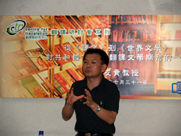
From Rendition to World Literature: An Inquiry into a Periodical in her First Three Decades of P.R.China (1949-1978)

Date: 31/07/2008
Time: 12:00 am - 12:00 am
Speaker: Professor Wang Yougui
Translation Seminar Series

As a consequence of the dominant sense of centralizing government and management and power, the People's Republic of China (PRC) had only one periodical that was officially circulated during her initial 29 years (1949-1977) for publication of literary works in Chinese translation.

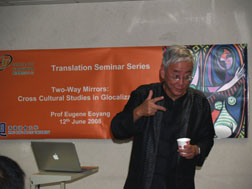
Two-Way Mirrors: Cross-Cultural Studies in Glocalization

Date: 12/06/2008
Time: 12:00 am - 12:00 am
Speaker: Professor Eugene Eoyang
Translation Seminar Series

Two-Way Mirrors: Cross-Cultural Studies in Glocalization posits a model of knowledge that stresses the dialectics of knowing, where any view of an object also provides (if one looks for it) a reflection of the subject. All knowing is, in this sense, positional, and deictic: where one is "placed" affects what and how one sees.

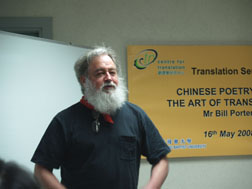
Chinese Poetry and The Art of Translation

Date: 16/05/2008
Time: 12:00 am - 12:00 am
Speaker: Mr Bill Porter
Translation Seminar Series

What is the nature of poetry, especially Chinese Poetry, and what is the nature of translation. Both are rooted in the tool humans use to understand one another called 'language'. But in the realm of poetry, what happens when we go from one language to another?

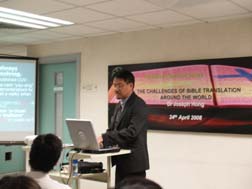
The Challenges of Bible Translation around the World

Date: 24/04/2008
Time: 12:00 am - 12:00 am
Speaker: Dr Joseph Hong
Translation Seminar Series

From the rendition of the sacred Hebrew text of Judaism into Greek about twenty-two centuries ago, to the translation of the Christian holy book into minority languages such as Tahitian and Gilbertese in recent decades, the enterprise of Bible translation continues to generate as much interest as passion among both non-believers and believers of the Judeo-Christian faith.

Consensual and/vs Conflictual Scholarship: Positioning the Translation Scholar in Society

Date: 27/03/2008
Time: 12:00 am - 12:00 am
Speaker: Professor Mona Baker
Translation Seminar Series

Growing awareness of the responsibility of the translator and interpreter in shaping geopolitical relations led to a surge of interest in the subject among translation scholars in the nineties and the early years of this century. Scholars engaging with issues of power and ideology in this context however tend on the whole to draw on historical examples which, while still highly relevant, have largely lost their political 'sting' - in other words, they are largely non-controversial, at least in scholarly circles: Irish history; British colonization of India; Spanish and Portuguese colonization of South America; gender and sexuality.

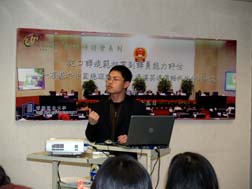
From Description of Norms in Interpreting to Assessment of Interpreter Competence – A Study Based on the Analysis of Corpus from C-E Consecutive Interpreting for Chinese Premier Press Conferences

Date: 15/02/2008
Time: 12:00 am - 12:00 am
Speaker: Mr Wang Binhua
Translation Seminar Series

雖然對社會文化語境中真實口譯活動的研究已初現端倪,但這種研究趨勢目前仍未進入口譯研究的主流視野。正如Pöchhacker(1995)指出的那樣,過去一直處於口譯研究中心地位的對口譯認知處理機制的研究並不能完全代表整體的口譯研究,而對社會文化語境中真實口譯行為和活動及其所涉及的諸多因素以及諸因素之間的互動關係,至今仍未有深入的研究。本研究的目標是,中國語境下職業譯員現場口譯活動規範的描寫研究,將採用國家總理朱鎔基和溫家寶1999、2000、2004、2005、2006年記者會連續傳譯的現場錄音為研究語料。

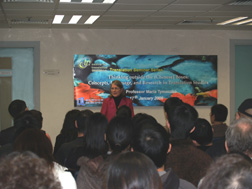
Thinking outside the (Chinese) Boxes: Concepts, Language, and Research in Translation Studies

Date: 17/01/2008
Time: 12:00 am - 12:00 am
Speaker: Professor Maria Tymoczko
Translation Seminar Series

Social concepts (such as translation, ethics, religion, theory) are widely variable across culture and language. How can academic disciplines be constituted without simplifying this variability and without becoming hegemonic? How can scholars avoid being trapped in the prison-house of their own language? How can scholarship break the confines of what has already been defined and developed?

Scroll to top