文化研究與翻譯研究
一個無可否認的事實是,翻譯研究 (Translation Studies) 已經呈現出一種多元途徑的格局。其中一個不可忽視的研究取向乃是"文化轉向" (cultural turn),雖然這一轉向實際早在二十世紀六、七十年代便已經開始,但直到二十世紀八、九十年代才獲得命名。然而,在這一轉向中,其實還有一種轉向也已悄然進行,我稱之為"文化研究轉向"。



Promoting discipline of translation
一個無可否認的事實是,翻譯研究 (Translation Studies) 已經呈現出一種多元途徑的格局。其中一個不可忽視的研究取向乃是"文化轉向" (cultural turn),雖然這一轉向實際早在二十世紀六、七十年代便已經開始,但直到二十世紀八、九十年代才獲得命名。然而,在這一轉向中,其實還有一種轉向也已悄然進行,我稱之為"文化研究轉向"。
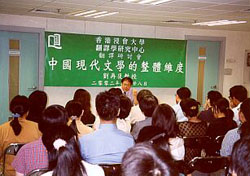
從文學維度的視角觀察中國現代文學的得失,並對中國現代文學進行宏觀的批評。
Yan Fu is best remembered for his translation of modern Western intellectual works and his epigrammatic "xin-da-ya" translation principles, generally taken to mean faithfulness to the original text, comprehensibility and elegance. It is a known fact that Yan's translation agenda is highly purposeful and that many of his commentary-translations are not faithful to the original texts.
When the academic discourse on translation has widely recognized the importance of text analysis, we need to ask ourselves two questions further: (1) how a text can be analyzed, and (2) what a text will be analyzed for. Indeed, "text analysis" is more than a convenient haphazard operation.
David Hawkes' translation of the first eighty chapters of Honglou Meng 《紅樓夢》 (The Story of the Stone) is justly acclaimed as a masterpiece of literary translation from the Chinese. In this presentation, an attempt will be made to characterize the distinctive features of Hawkes' methods as a translator.
In the etymological sense, both metaphor and translation signify an act of transference, of carrying something across, and that basic sense should help us understand the nature of translation. I shall discuss a number of important theoretical and critical discussions of the problem of translation, and of translatability in particular, and I shall argue for translation not just as a technical issue of finding equivalence between languages, but first and foremost the necessary means of understanding and communication across the gaps of cultures, histories, and traditions.
The linguistic and rhetorical norms of the target language and culture have always been a crucial element in the theory and practice of translation. These preferences invariably compete with another set of textual norms already in place as part of the language user's rhetorical competence. Included here are such variables as educational background, orate vs. literate predilections, mother tongue's linguistic/rhetorical preferences, etc.
The use in translation studies of methodologies inspired by corpus linguistics has proved to be one of the most important gate-openers to progress in the discipline since Toury's re-thinking of the concept of equivalence. In this paper, I argue that, the many advantages to be had by this method notwithstanding, there are problems.
The speaker will ask why these two disciplines have stood apart for so long and what can be done to bring about a rapprochement between them. The relative neglect of interlingual topics in lexicography and of lexicographic topics in translation will be demonstrated, and the special case of parallel text analysis will be examined to show how progress in interdisciplinary collaboration can be made.
本文首先回顧20世紀中國(以內地為主,下同)的翻譯家研究及其現狀,分析其特點,並提出筆者的看法。筆者將中國的翻譯家研究大致分為五種類型:刊物上的文章介紹、翻譯家評傳、翻譯家詞典、文學史研究中的翻譯家研究和專題翻譯家研究。各種類型的研究都有自己的特點:刊物上的文章發表及時且針對性強,但受篇幅限制且比較零散;翻譯家評傳能夠闡述充分透徹,但往往因傳主故世而限制了研究的範圍與視野;翻譯家詞典簡明扼要信息量大,但入選標準把握不一,質量參差不齊;文學史研究中的翻譯家研究目前還不夠系統深入,但發展趨勢很好;專題翻譯家研究主題明確材料生動,但往往不易充分展開。